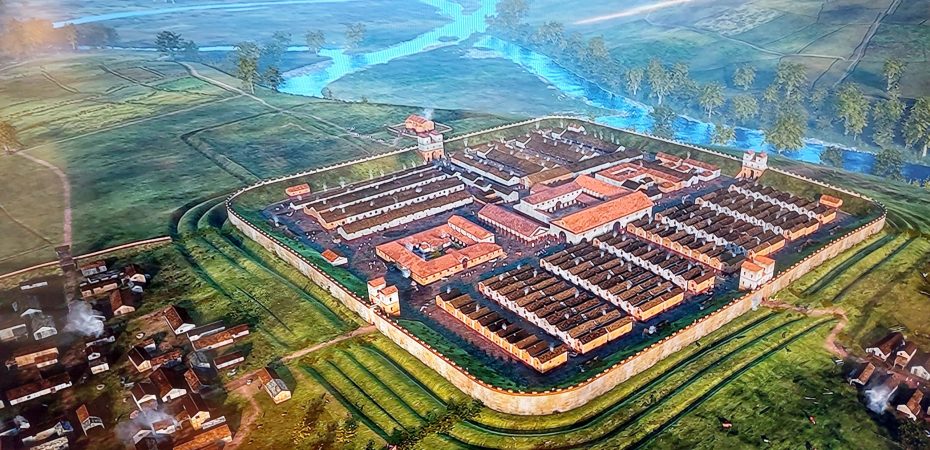
All Roman forts and camps across the empire followed the same basic layout for hundreds of years with minor alterations according to the composition of the unit stationed there.

A Roman fort, or castrum, was a military camp designed for defence and efficiency. The layout was typically rectangular with playing card curved corners surrounded by fortified walls and ditches. Every fort in the empire was laid out in a similar fashion with minor differences inside.
Principia (Headquarters Building):
Located at the centre of the fort, the Principia was the administrative heart. It featured a central courtyard, a basilica (large hall), offices for clerks, and a shrine (sacellum) that housed the standards and religious icons. Beneath the shrine, there was often a secure underground room, the aerarium, where the legion’s pay chest was kept.

Praetorium (Commander’s House):
The praetorium was the residence of the fort’s commanding officer. It was a large, well-appointed house, reflecting the high status of its occupant. It typically had several rooms, including private quarters, reception rooms, kitchens, and baths, often arranged around an internal courtyard.

Barracks (Contubernia):
The barracks housed the soldiers and were usually long, rectangular buildings divided into sections. Each section, or contubernium, accommodated a group of eight soldiers. These buildings were functional, with sleeping quarters, a common room, and sometimes a small courtyard.

Granaries (Horrea):
Granaries were essential for storing food supplies, particularly grain. They were built with raised floors to prevent moisture from spoiling the food and often had thick walls for insulation. Ventilation was also a key feature, ensuring the grain remained dry.

Workshops (Fabricae):
The fabricae were workshops where tools, weapons, shoes and other equipment were made and repaired. These buildings were vital for maintaining the army’s readiness and were typically found near the granaries.

Hospital (Valetudinarium):
A valetudinarium was the fort’s hospital, where injured or sick soldiers were treated. It consisted of multiple rooms arranged around a courtyard, including wards, a kitchen, and sometimes a bathhouse. It was designed to accommodate large numbers of patients with efficient medical care.

Bathhouse (Thermae):
The bathhouse was a crucial part of Roman life, even in military forts. It included a series of rooms for hot baths (caldarium), warm baths (tepidarium), and cold baths (frigidarium). The bathhouse also served as a social hub where soldiers could relax and interact.

Stables (Stabula):
Stables were built to house the fort’s horses, necessary for cavalry and transport. Soldiers stayed in the same quarters as their horses living in an area above the horse.
Storehouses and Armories:
Additional buildings were dedicated to storing weapons, armour, and other military equipment. These were secure and often located near the barracks or the headquarters.
Latrines:
Latrines were communal toilets, typically located near the barracks. They were connected to the fort’s drainage system, which was an advanced feature of Roman engineering, ensuring cleanliness and hygiene.

Walls and Gates:
The fort was enclosed by thick stone walls with towers at intervals for defence. Gates allowed access in and out, each typically fortified with guardhouses. The main gates were positioned at the cardinal points, leading to the main roads outside the fort.

The fort was intended to inspire and keep soldiers safe. Very often civilian buildings and other enclosures were built nearby. Roman camps were frequently made in the vicinity of a fort. Two further layouts are below and detailed layouts of forts can be found at Castleshaw Roman Fort and Fortlet and A Short Guide to Buildings within the Fort for Segedunum,

Forts were always placed near water and usually in the bend so that the river gave an additional level of protection. Horses need access to a regular and plentiful water supply and barges transport goods upstream sometimes pulled by a horse. The Romans, Rivers and Valleys page shows the placement of forts all over Scotland on how each fort and camp is on a river.

Click on the image for more maps of forts and rivers
 Roman Corstorphine